
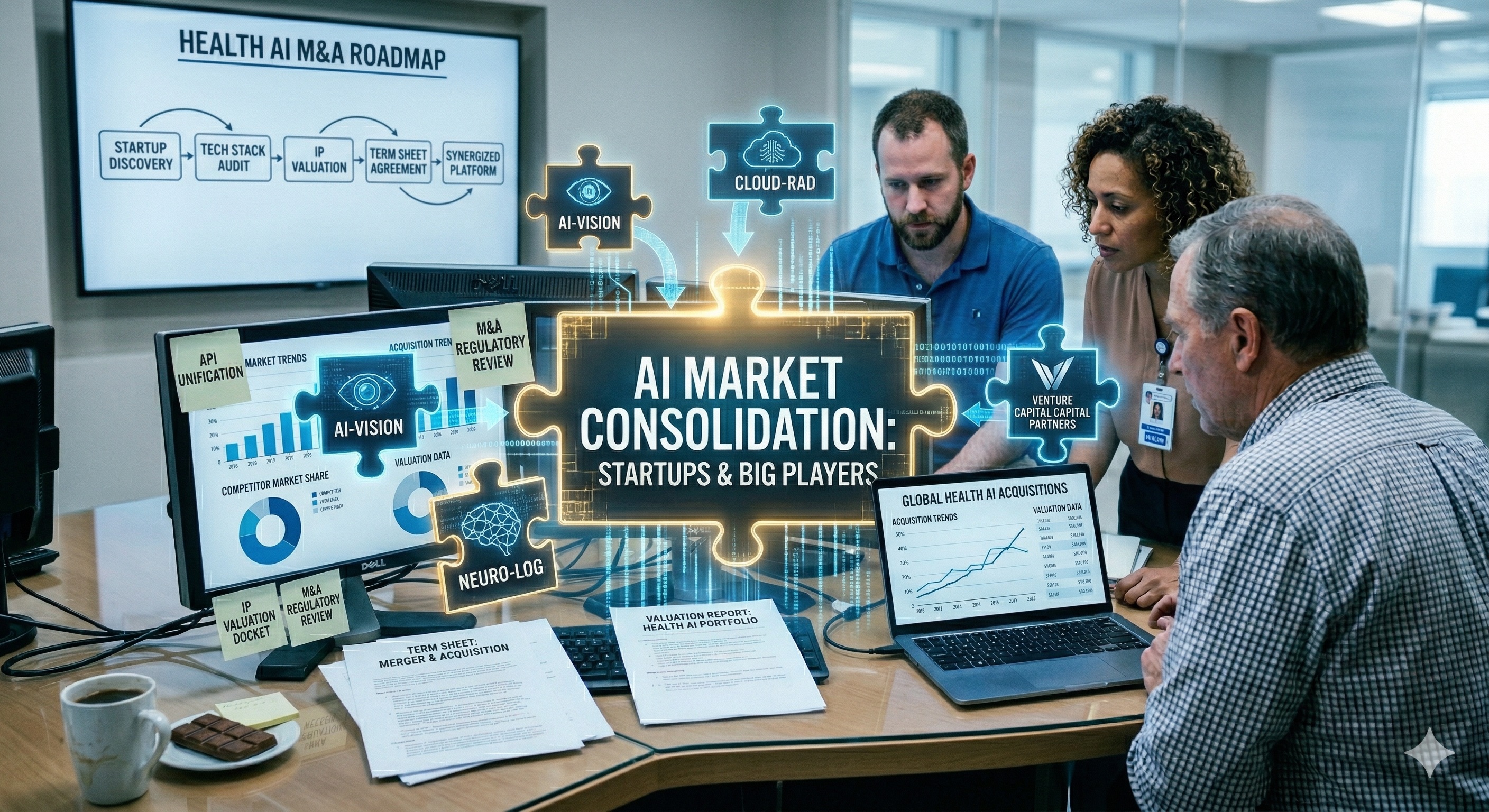
DeepHealth acquires Gleamer. Radiobotics merges with Medimaps. Oxipit acquired by Sectra. A few more deals in the pipeline. Viewed from the outside, it appears that the radiology AI market is finally simplifying. Is it?
The fact of the matter is that some of the earliest companies in this space, many of which raised funding eight to ten years ago, are reaching a natural point in their lifecycle and at this point, an exit needs to be provided to investors, which could be either by way of an IPO or an acquisition. This is why we are seeing AI providers being absorbed into larger imaging and software players. These are liquidation events, not structural changes in a fragmented market leading to consolidation.
Radiology AI continues to remain fragmented because radiology itself is fragmented. Different modalities, disease areas, workflows, scanner environments, patient populations and commercial realities continue to require different solutions. A change in who owns a product may affect packaging and go-to-market strategy (and sometimes, not in the best way) but it most certainly does not remove the need for multiple products across multiple use cases.
There are three main reasons why this matters:
1. High-adoption use cases are not consolidating. They are proliferating.
The companies being acquired today built their names in the highest-adoption clinical areas: neuroimaging, chest CT, chest X-ray, fracture X-ray and mammography. Because these names were the most visible, their consolidation creates the impression that the category is narrowing. It is not. As it becomes easier to build AI solutions and take them through regulatory pathways, we come across companies building these exact use cases that most people in the industry have never heard of. Some are more specialized while some offer a different performance profile. Some are approaching the same clinical problem at a fundamentally different price point or with regulatory clearances in markets others have not entered. The first generation may be consolidating. The second and third generations are already here, and the options available to radiologists are increasing.
2. High-value, low-volume use cases remain structurally fragmented
Beyond the high-traffic use-cases lies a growing set of narrower, high-value use cases: FFR-CT, brain volumetry, prostate MRI, dental imaging and others. These areas were never going to be served well by large portfolio players since the volumes aren’t large enough for these players to justify investing into developing niche use-cases. What we are seeing is that the number of providers in these segments is growing, not shrinking. Each new entrant addresses a narrower slice of clinical needs with deeper domain focus. That is the opposite of consolidation. That is specialization at scale.
3. New AI categories are still being created
Then there is a third layer that barely features in consolidation narratives: use cases where radiology AI is only now beginning to appear. AI that provides end-to-end analysis or A-to-Z radiology intelligence (no pun intended), spine MRI analysis, radiomics and radiogenomics and many others that are still taking shape. These are areas where the first credible solutions are just entering the market and the landscape is entirely open – we don’t even know what to expect! No amount of M&A among first-generation companies addresses this frontier. It is being built from scratch, by new teams, often in new geographies, going beyond the norm of addressing common use cases for a safe valuation-based approach. The strategy is truly moving from one that’s aimed at an exit (read acquisition), towards one that’s centered around clinical impact keeping patient’s first!
Add to all of this something that does not get discussed enough: large imaging and adjacent healthcare companies, think United Imaging, Guerbet and others, who are deep into AI, are distributing their solutions through platforms like ours. When OEMs enter the AI layer, fragmentation does not decrease; rather it deepens, because these are well-resourced players adding new solutions to an already crowded field that are customized and tailored around their hardware.
One thing that most consolidation narratives miss entirely is that the value of a radiology AI solution is a function of both performance and price. Two solutions addressing the same clinical use case can differ meaningfully on accuracy for a given patient population, integration complexity, pricing structure and total cost of deployment. When you have many options across several different use cases, the question is no longer whether AI exists for a given clinical need. The question is which AI is the right fit (and “fit” evolves over time!). That is a problem only an open, neutral marketplace can address at scale.
For healthcare providers, the challenge has already shifted. It is no longer about access. It is about navigation, validation and (again) fit. Providers need to determine which solution performs reliably in their own clinical environment, with their own scanners, protocols, reading patterns and patient populations. A bundled portfolio may be easier to procure. That does not make it the best fit for each use case. The industry does not need fewer solutions packaged into tighter ownership structures. It needs better infrastructure to ensure choice expansion while staying neutral, and focusing on the patient. That is the role of an independent marketplace. Not to force convergence around ownership, but to help providers evaluate solutions on merit, compare across vendors, validate performance and deploy the right tools without commercial bias.
Recent M&A may simplify the headlines but it does not simplify the fragmentation. At most, it changes who owns some of the products. It does not change the underlying diversity of clinical needs, workflows and commercial trade-offs that make this a multi-solution market.
There has never been a better time to build a radiology AI product - a multi-solution market will always require a multi-solution and neutral marketplace with the right validation and monitoring tools to empower and enable radiologists to adopt AI of their own choosing!
PS – we haven’t even start talking about radiologists building their own AI! (yet!)
